What You Cannot See Will Cost You: The Network Observability Crisis Quietly Undermining Enterprise Incident Response
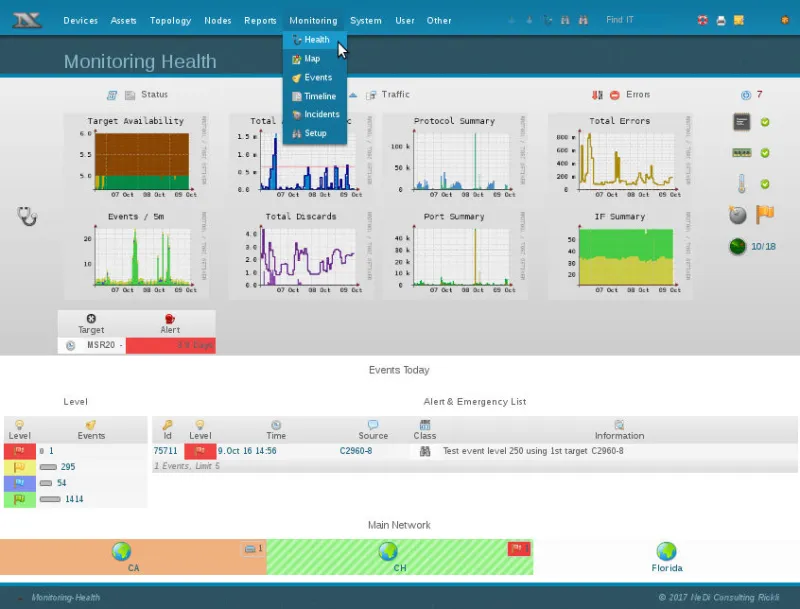
Photo: Ricklir, CC BY-SA 4.0, via Wikimedia Commons
There is a particular kind of organizational confidence that proves most dangerous in enterprise IT: the belief that because monitoring dashboards are lit up with data, the network is truly understood. Across US enterprises of every size, that confidence is being tested—and frequently broken—by the widening gap between what observability tools report and what is actually occurring across distributed infrastructure.
The consequences are not abstract. When an incident emerges from a blind spot, incident response teams are not simply delayed. They are disoriented, working backward through fragmented telemetry, reconstructing timelines from incomplete evidence while systems degrade and business units escalate. The operational and financial toll of that disorientation is significant, and it is growing.
The Illusion of Comprehensive Visibility
Most enterprise environments did not arrive at their current monitoring architecture through deliberate design. They accumulated it—one tool for application performance, another for infrastructure metrics, a third for log aggregation, perhaps a fourth introduced when a cloud migration brought new requirements that existing platforms could not satisfy. The result is a patchwork observability stack that, on paper, appears thorough.
The problem is that patchwork stacks produce patchwork insight. Each individual tool may function exactly as its vendor intended, yet the spaces between those tools—the correlation gaps, the latency in data handoffs, the inconsistent telemetry taxonomies—are precisely where complex incidents choose to hide. A network anomaly that begins at the infrastructure layer may not surface meaningfully in application performance data until minutes or hours later. By that point, the causal chain has grown long and the remediation window has narrowed considerably.
For IT leaders managing hybrid environments that span on-premises data centers, multiple cloud providers, and an expanding portfolio of edge deployments, these gaps are not edge cases. They are structural features of how modern enterprise networks operate.
Where Blind Spots Originate
Observability blind spots in enterprise networks tend to cluster around a handful of predictable failure points, each of which deserves direct examination.
East-west traffic within cloud environments remains poorly understood by many organizations. North-south traffic—the flows between internal systems and external endpoints—has historically received the majority of monitoring attention. But lateral movement within cloud VPCs and virtual networks, where sophisticated threats increasingly operate, often falls outside the visibility perimeter of traditional network monitoring tools.
Third-party and SaaS integration points represent another persistent gap. When enterprise workflows depend on external platforms, the network paths traversing those integrations typically lack the granular telemetry that internal infrastructure provides. Incidents originating or amplified at these boundaries are frequently invisible until they manifest as user-facing failures.
Containerized and microservices-based workloads generate telemetry at a volume and velocity that many legacy monitoring platforms were not designed to process coherently. The result is data that exists but cannot be acted upon—observability in name only.
Distributed edge deployments, increasingly common as enterprises extend compute capacity closer to operational environments, introduce network segments where monitoring coverage is inconsistent at best. Remote sites, IoT-adjacent infrastructure, and branch office environments frequently operate with monitoring configurations that have not kept pace with the complexity of the workloads they now support.
The Incident Response Penalty
When observability gaps exist, the incident response process absorbs the cost. That cost manifests in several compounding ways.
Mean time to detect—MTTD—extends when monitoring systems lack the coverage or correlation capability to surface anomalies as they emerge rather than after they have propagated. Extended detection windows allow incidents that could have been contained to expand into broader outages or data exposure events.
Mean time to resolve—MTTR—suffers separately, as response teams spend investigative cycles reconstructing what happened rather than executing remediation. Engineers working from incomplete telemetry frequently pursue incorrect hypotheses, consuming time and focus that could otherwise be directed toward resolution. In high-stakes environments where service-level agreements carry financial penalties, every additional hour of ambiguity translates directly to measurable cost.
Beyond the immediate incident, fragmented observability erodes the quality of post-incident review. When root cause analysis depends on evidence that was never captured or cannot be reliably correlated, organizations lose the institutional learning that would otherwise reduce the likelihood of recurrence. The same class of incident resurfaces, and the cycle repeats.
What Genuine Observability Requires
Addressing observability blind spots is not primarily a matter of acquiring additional tools. In many cases, enterprises already possess more monitoring instrumentation than their teams can effectively manage. The deeper challenge is architectural: ensuring that telemetry from across the network can be ingested, correlated, and surfaced in a manner that supports rapid, accurate decision-making during an incident.
This requires deliberate attention to several foundational elements.
Unified telemetry correlation is the capability that most fragmented stacks lack. When metrics, logs, and traces from disparate sources can be correlated against a shared timeline and topology model, the spaces between tools become navigable rather than opaque. Investments in observability platforms that provide this correlation layer—rather than simply aggregating data in parallel silos—yield disproportionate returns in incident response effectiveness.
Topology awareness matters considerably in distributed environments. Monitoring tools that understand the relationships between network components, not merely their individual states, can surface the propagation paths of incidents in ways that isolated metric alerts cannot. When a degradation event begins at one node and cascades across dependent services, topology-aware observability identifies the origin rather than simply cataloging the symptoms.
Continuous coverage validation is a practice that few enterprises currently maintain but that directly addresses blind spot accumulation over time. As infrastructure evolves—new cloud regions, acquired business units, expanded edge footprints—monitoring coverage that was adequate six months prior may no longer reflect the actual topology. Periodic, systematic review of where telemetry is and is not being collected prevents the gradual erosion of visibility that characterizes many enterprise environments.
The Strategic Imperative for IT Leadership
The conversation about network observability has too often been framed as a tooling conversation—which platform to select, which vendor to consolidate around. For enterprise IT leaders, the more important framing is operational: what does it cost when an incident response team cannot see clearly, and what investment in observability capability is justified by that cost?
In environments where digital operations underpin revenue generation, customer experience, or regulatory compliance, the answer is almost invariably that the investment is justified. The question is whether it is being made deliberately, based on a clear-eyed assessment of where visibility currently breaks down, or reactively, after an incident has already demonstrated the consequences of a blind spot.
US enterprises navigating the complexity of modern distributed infrastructure cannot afford to treat observability as a background concern. The networks that power today's operations are too dynamic, too interdependent, and too consequential for incomplete visibility to remain acceptable. Closing the gaps is not a future project—it is a present operational requirement.